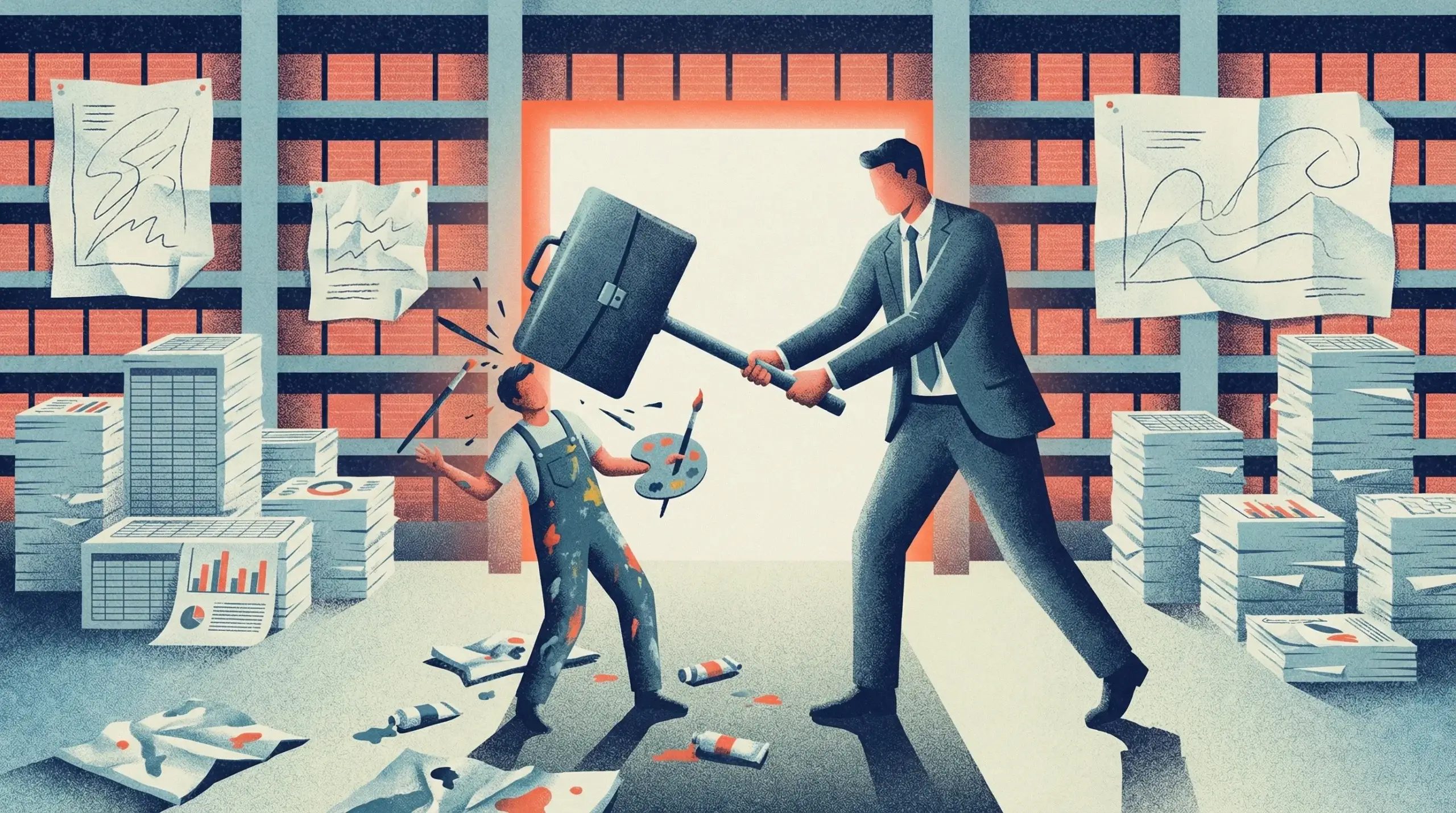
Why are we in this mess?
At least not on its own. We are inclined to think AI is what has gotten us here because it's the latest thing, and it's how it's being marketed and talked about on social media.
Series: Design agencies are fucked
In this series of posts I will be diving deep into the topic of design as a service, and try to figure out why are creative services so strongle being devalued in today's market.
Why are we in this mess? (you are here)
Being the cesspool that it is, social media is overflown with grifters working their asses off to take advantage of every single insecurity a person working in the creative industry might have, all for clout. Making creatives fear AI is just their most recent angle to farm attention.
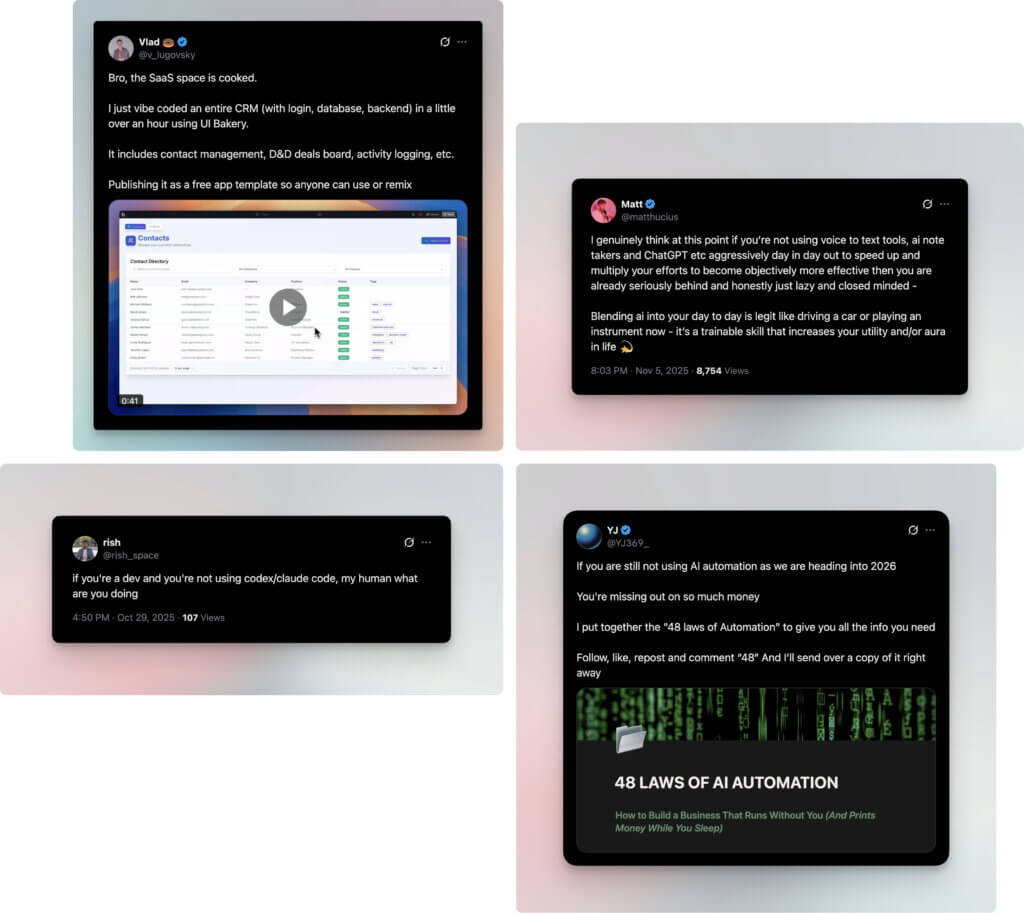
These assholes and their pity agenda are just the most recent factor of continual devaluation of creative services, an event which has been happening for a couple of decades now.
Get a job, loser
What I really think is happening is that the creative industry is simply maturing, and with maturity comes proficiency and commodification.
The easy parts of design have been commodified. Anyone can execute, and produce derivative work based on the most recent trend. The hard part is what's still very much in demand, and that is the less talked about part of design work: the strategic thinking, the holistic approach to shaping brands and products, the application of design principles in ways that have nothing to do with visual design.
Design as a practice has grown out of its teenage phase and is expected to work. There isn't anything particularly interesting, or fresh about applying design principles to business. What was once innovation, is now expected, and it's expected to produce measurable results.
This is something design has always struggled with, it has this duality to it. One can get to a successful outcome with design by wringing it into submission with processes, systematization, and iterative improvement based on measurements. But at the same time one can just yolo it to great success. Designers strongly prefer the latter, the business insists on the former. Designers never had a good argument for the creative free-flow approach, so the business' way to do design has won.
To many this means that design has lost its magic, and to an extent it has. No one—apart from designers themselves—is talking about design as something magical and special. No one wants weird and magical anymore, they want a service which produces reliable, and repeatable results. Something they can rely on.
This is why The Business has pushed so hard for efficiency in design. They want it faster. This is why they have supported the development of design systems within digital products. They want it repeatable and reliable.
The creative part of design—the only part worthy of their time, as designers tend to think—has been scaled down to a mere phase and trusted only to the ones which have proven they understand the problem space so well (the seniors, principals, heads of, etc.). Everything else is commodified and expected to be executed as efficiently as possible, without error, by whomever—even AI.
See, The Business has been at this for a while now. First they wanted spec work because they wanted to escape paying for something they didn't understand (I'll know it when I see it).
Then they took it offshore to make it cheaper. A lot of people have gotten very rich because of this. Operating cost has always been Superawesome's competitive advantage, up until recently at least.
Then they needed it faster, in more volume, and in more formats than you could imagine because social networks became social media and it is their main advertising channel now.
Each step made designers hate their jobs more and more because it made them perform in an increasingly different context.
The main reason design and business are at such odds is the fact that design by nature doesn't even recognize time and effort as inputs, while for the business they are tangible cost which they ruthlessly want to reduce.
So, AI didn't “ruin the creative industry”. The Business has been working on devaluing and bending creative work—as we were taught it should be— to their needs for a good while, now.
We need to take a good look at ourselves in the mirror, and admit to ourselves that if we want to practice design within the context of business, it's going to go through the same treatment every other tool of business has gone through.
Now back to AI
What AI did do though, is to enable designers to meet the new demands the business has put on them. Instead of the killer of creativity, designers should treat AI as a tool which augments them and their creativity. Drawing tablets didn't kill illustration or painting. Image editors didn't kill photography. 3D software didn't kill animation or movies. AI won't replace creative workers as long as they use it to enhance their work, not to do their work for them.
However, one part of creative work which is affected by AI is the execution part. The part which people can do without thinking, or knowing a lot. To be honest, I'm here for it. I'm all for freeing up people's time to use it in a more creative, more human way.
The only thing we are yet to figure out is the educational part of low skilled repetitive work: we rely on it to hone the skills of younger people. And those people can't jump in to higher, more delicate creative work without spending a lot of time practicing with simpler work. Well, they can, but I just don't think it is a good idea. We'll know soon enough.
The old school business model of design isn't working for the new school business
So, I've gotten to the conclusion that design is not “ruined”, it's just finally being used as a tool for business, and that affects it greatly.
The business models agencies used so far aren't working anymore, and an agency isn't an interesting asset from a business perspective.
Creative services, design in particular, is a mature practice, and business can with full confidence expect to run it in house. The way agencies are operating is too slow (too much “process”) and unpredictable (it's behind closed doors), and the price tag is too much because people understand much better what they are paying for.
Design as a service needs to come up with a new model of serving the business. What will it be?
The new qualities of design as a service
I've identified some qualifying attributes creative agencies need to develop in order to remain in business.
Aesthetic agnosticism
The ability to produce work which resonates aesthetically in the moment and captures the zeitgeist is more important than retreating into a dark cave, and crawling out with what will most likely be outdated and unusable research material. Social media has changed the way the world consumes things, and thus the output of creative work must change in order to stay relevant.
Agencies can't afford to have a “style”, or to operate in an aesthetic niche. They need to be able to stylistically execute on demand.
Work efficiency
The work needs to be executed very quickly because business in general has accelerated. No one has time for design theatre, and creatives need to learn to think through their work, and perform it from end to end. Designing acutely is out. Doing systematically is in.
Cost efficiency
The collaboration needs to be a financially responsible decision for the business. Long gone are the days of hiring an agency for absurd amounts of money in order to buy credibility (think hiring Pentagram back in the day).
On the agency side, the trick is to find a way to attract and retain the right talent. You don't want people that would rather be in-house. You want people that want to be continuously challenged, and are not solely financially motivated.
Operational efficiency
Moving on from the “project” mindset into the “problem space owner” mindset, and adjusting your entire operation to allow for that is what's required to be an effective partner for your clients. This means coming up with a new org chart which isn't assigning people to accounts. Your staff needs to move horizontally, and be able to work across-accounts.
No one cares who does the work, or how long it took as long as it's done right, and on time.
Agency
Ironically, agencies are lacking agency. Traditionally, agencies were waiting for clients to create a request for work, now clients are expecting the agencies to simply figure out what they need to work on themselves. This requires a deep understanding of the problem space by the agency, a good internal knowledge sharing practices, and possibly a new billing model.
Agencies need to figure out a way to integrate into their client's organizations, and become less of their own entity, and more of an extension of the client org.
 5
5 5
5 1
1What's this?
You are reading his blog.